Football writer Ben Bloom analyses why the Premier League is delivering more late drama in 2025/26 than in previous seasons.
It happened again at the weekend. And then again. And again.
During the course of Matchweek 24, no fewer than five Premier League games featured goals being scored after the 90th minute, with three of those altering the outcome of the contest.
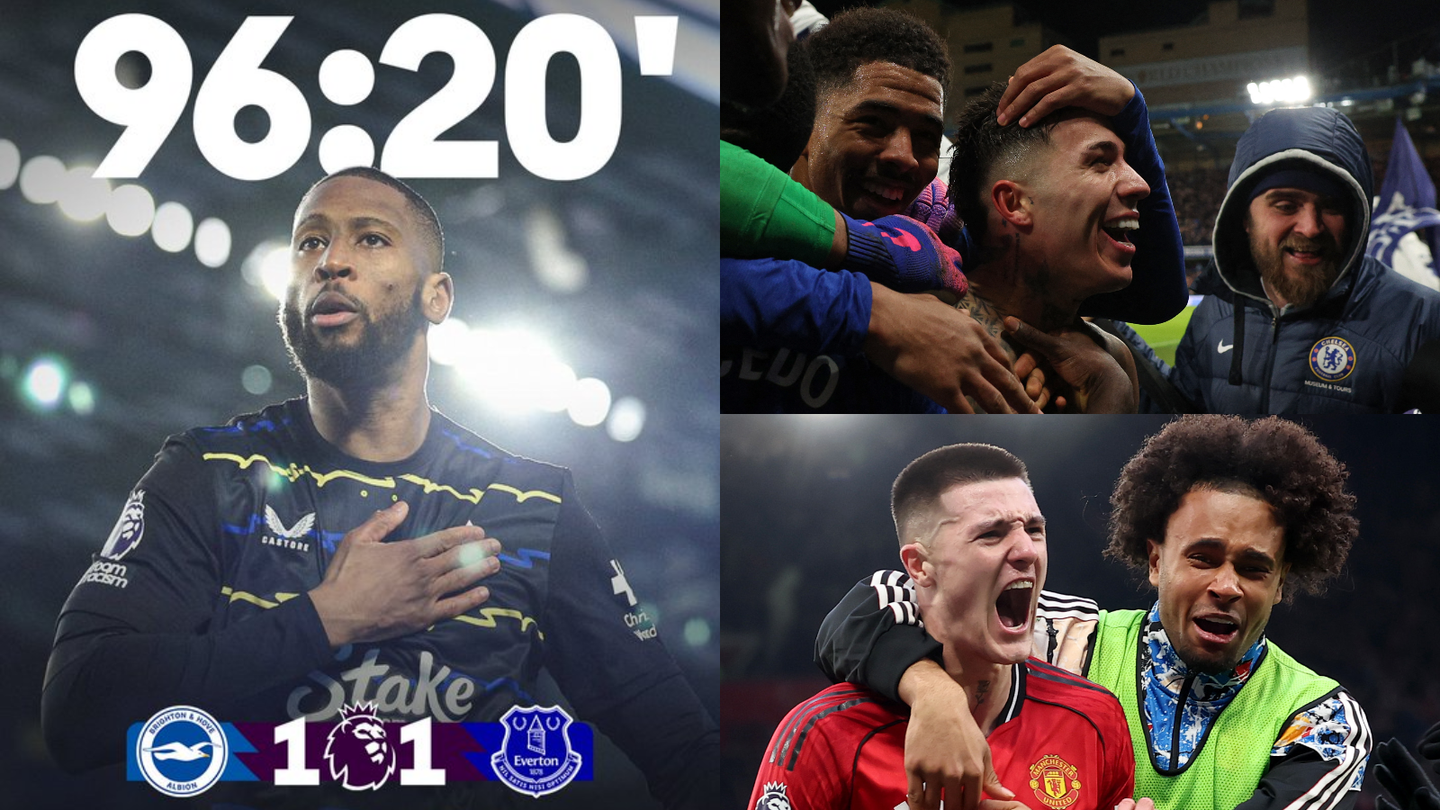
It began on Saturday with Beto's equaliser for Everton at Brighton & Hove Albion:
From the bench to scoring an equaliser in a matter of moments!🏃
— Premier League (@premierleague) February 1, 2026
BIG moment from Beto for @Everton 🔵 pic.twitter.com/UrAveCKNwc
It continued with Enzo Fernandez completing a dramatic comeback win for Chelsea against West Ham United:
Goal reactions don't get much better than this from Liam Rosenior... 🎬
— Premier League (@premierleague) January 31, 2026
🔵 @ChelseaFC pic.twitter.com/2pdYjnWtt6
It culminated with Benjamin Sesko smashing in a late winner for Manchester United at home to Fulham:
🍿 🍿 🍿
— Premier League (@premierleague) February 1, 2026
The closing stages of @ManUtd v @FulhamFC had us on the edge of our seats 🤩 pic.twitter.com/4wsnDtn01R
Three decisive stoppage-time goals in one weekend. Intriguingly, such events are fast becoming normal in 2025/26.
Never before has there been a Premier League campaign with so many decisive late goals, with the 24 stoppage-time winners scored so far already surpassing the 22 scored in the entirety of last season.
We are not even two-thirds of the way through 2025/26, but already it promises to go down in the record books as one of the most dramatic seasons ever.
More stoppage time, more late goals
Many football fans will be aware that a new directive to combat time-wasting was introduced ahead of the 2023/24 season, resulting in an increase in stoppage time.
Suddenly, late goals became more prevalent than ever, with teams naturally using the additional minutes to score. Matches lasted more than 100 minutes on average in 2023/24 and the same is true again this season.
PL after Matchweek 24 - Last three seasons
| 2023/24 | 2024/25 | 2025/26 | |
| Matches | 238 | 240 | 239 |
| Goals | 767 | 729 | 666 |
| 90+ min goals | 73 | 68 | 76 |
| % of all goals scored in 90+ | 9.5% | 9.3% | 11.4% |
| Decisive late goals (win or draw) | 31 | 31 | 41 |
| Avg. match time | 101:43 | 99:56 | 100:20 |
| Avg. time ball in play | 58:34 | 57:05 | 55:35 |
As the table above shows, despite significantly fewer goals being scored at this stage of the season compared with the past two campaigns, the proportion of goals coming in stoppage time is far higher: 11.4 per cent in 2025/26, compared to 9.3 per cent in 2024/25 and 9.5 per cent in 2023/24.
Decisive late goals resulting in a win or a draw are also forming a greater proportion of all goals: 6.2 per cent (41 of 666) in 2025/26, compared with 4.3 per cent (31 of 729) in 2024/25 and 4.0 per cent (31 of 238) in 2023/24.
One of this season's 41 decisive late goals so far — Harvey Barnes’ strike to give Newcastle United a spectacular 4-3 victory over Leeds United in January — was timed at 101 minutes and 48 seconds, making it the latest-ever winner scored in the Premier League.
Watch Barnes' record-breaking winner
Harvey Barnes. 90+12.@NUFC ⚫️⚪️ pic.twitter.com/YRMrXRLZAI
— Premier League (@premierleague) January 8, 2026
Newcastle had actually been a goal down entering stoppage time, before Bruno Guimaraes found an equaliser and Barnes then sealed the win.
Dig into the data further, and the outlier nature of the 2025/26 season is even more apparent.
Bearing in mind that only 24 of the 38 Matchweeks have been played this campaign, the 76 stoppage-time goals in 2025/26 is already higher than all bar seven of the 33 completed Premier League seasons.
Indeed, just three more winners scored after the 90th minute this season would equal the all-time Premier League record of 27, while another three equalisers would match the record of 20.
At the current rate, both marks will disappear before the end of February.
Which teams are leaving it late?
Topping the table for injury-time goals this season are Liverpool and Brentford, both of whom have scored six times after the 90th minute.
Liverpool – courtesy of Rio Ngumoha against Newcastle and Mohamed Salah at Burnley – are one of eight different teams to have twice struck stoppage-time winners, alongside Arsenal, AFC Bournemouth, Chelsea, Fulham, Man Utd, Newcastle and Sunderland.
Watch Ngumoha's late winner
16-year-old Rio Ngumoha, Liverpool's newest hero! ❤️ pic.twitter.com/qwmUpIBHrI
— Premier League (@premierleague) August 25, 2025
With late goals against Burnley, Newcastle and Wolverhampton Wanderers, Spurs top the table for equalisers scored after the 90th minute.
Why is there more late drama this season?
While the aforementioned increase in stoppage time is one factor, a piece by Opta Analyst suggests a number of other theories, including deeper Premier League squads allowing managers to better use their five substitutions.
There is also a suggestion that increased intensity of play means defenders might be tiring late on in games, which perhaps makes them more susceptible to their opponents' set-pieces.
The lower number of overall goals (666) at this stage of the season – compared to 767 and 729 in the past two campaigns – also means matches are likely to be tighter than previously, perhaps encouraging teams to push forward in the hunt for late goals that have a higher chance of impacting the result.
Whatever is behind it all, the increase in late drama should compel us all to keep our eyes on the action until the final whistle.