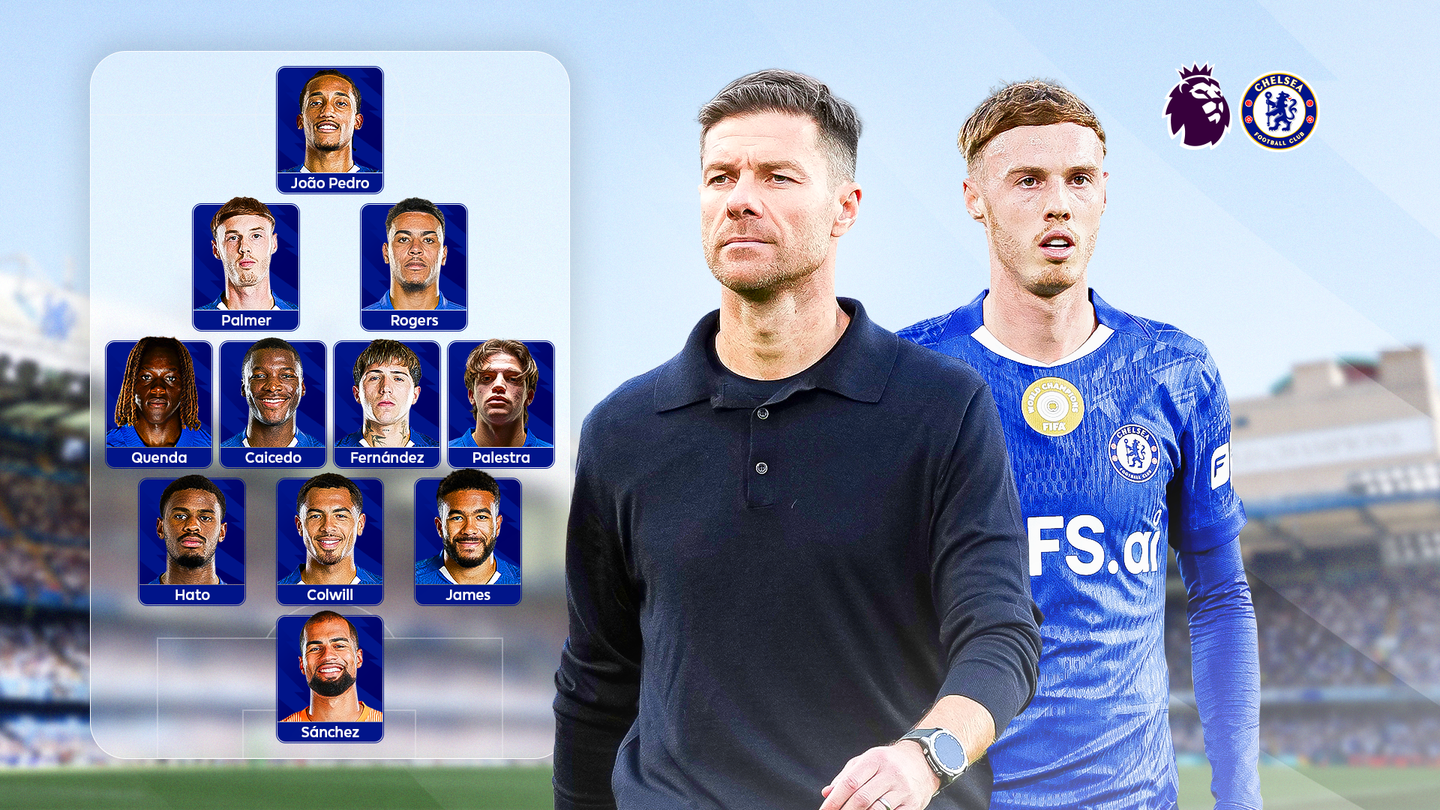
Xabi Alonso has officially started work as Chelsea's new manager after meeting his players and overseeing his first training session on Thursday.
"To be part of this great club that is one of the best in the world, with great success in the last decades... it's a big privilege to be a part of it," he told the club's in-house media on day one of his tenure.
The Spaniard's move to the Blues is one of the most exciting - and intriguing – managerial appointments in Premier League history.
Alonso’s unprecedented success at Bayer Leverkusen, where he won the Bundesliga title without losing a single match, has made him arguably the most sought-after coach in world football.
Watch: Alonso's first interview as Chelsea manager
Alonso's first words. 📺Watch Xabi’s first interview as Chelsea Manager on CFC+. 🫡
— Chelsea FC (@ChelseaFC) July 9, 2026
Even for a club of Chelsea’s size his signing is something of a steal.
But Alonso arrives at Stamford Bridge after an unsuccessful spell at Real Madrid, and, more significantly, his preference for a back-three formation comes with all the usual baggage in English football.
On the one hand, Chelsea’s last Premier League title was won in a 3-4-3 formation under Antonio Conte in 2016/17. On the other, Ruben Amorim’s back-three formation at Manchester United was often condemned as an unworkable formation at the top of English football.
But Chelsea are primed for a revolution and in Alonso they have a project manager ready to build something completely new.
Guardiola's influence and similarities to Maresca
Alonso lasted just six months at Real despite winning an impressive 45 points from 19 La Liga matches, suggesting he was not to blame for the breakdown at the Bernabeu.
It was a difficult time for Alonso at Real, where, navigating a complex power struggle, he let go of his tactical ideas in favour of a more conventional 4-3-3, which is why we will focus solely on his Leverkusen spell to analyse the tactics Chelsea fans can expect.
It was an extraordinary tenure, defined by his second full season in charge, 2023/24, when Leverkusen won the Bundesliga and the DFB-Pokal (German Cup) and lost just one of their 53 matches in all competitions – the very last fixture, the UEFA Europa League final against Atalanta.
He did it playing ruthlessly choreographed possession football combined with pressing opponents high up the pitch with intensity as soon as possession was lost.
Day one. pic.twitter.com/3h6MPziUlI
— Chelsea FC (@ChelseaFC) July 9, 2026
The idea is suffocation and territory: long-passing moves are worked meticulously to dominate space and opponents are drawn out of position to press. The ultimate aim is to overwhelm the opposition.
In essence, Alonso is a disciple of Pep Guardiola, his manager at Bayern Munich, which of course means he shares tactical ancestry with his Chelsea predecessor Enzo Maresca, who has now succeeded Guardiola in the Etihad Stadium dugout.
Comparing Maresca’s only full season at Chelsea in 2024/25 to Alonso’s peak at Leverkusen in 2023/24, we can see the stylistic similarities, albeit with harder pressing numbers for Alonso.
Compared: Bayer Leverkusen, 2023/24 v Chelsea, 2024/25
| Alonso's Leverkusen 23/24 (League rank) | Maresca's Chelsea 24/25 (League rank) | |
| Possession % | 62.1% (1st) | 56.8% (4th) |
| Direct speed | 1.71 (18th) | 1.64 (17th) |
| Passes per sequence | 5.01 (1st) | 4.3 (2nd) |
| High turnovers | 10.8 (1st) | 7.8 (9th) |
*Scroll across to see full table
As the graphic below shows, Alonso, like Maresca and Guardiola, preaches slow and intricate build-up play, favouring more passes per sequence than quick direct attacks.
However, having been influenced by a number of managers he played under, including Rafael Benitez and Carlo Ancelotti, Alonso will adapt his strategy to become more pragmatic when necessary, such as in the a 3-0 victory over Bayern Munich in February 2024, when Leverkusen sat back (39 per cent possession) and sprung on the counter-attack.
Alonso’s 3-4-3 formation presents a significant tactical shift for the Premier League
But a willingness to adapt to a more pragmatic tactical approach is not the biggest difference between Maresca and Alonso.
By far the largest - and the most contentious aspect of this appointment - is Alonso consistently deploying a 3-4-3 formation at Leverkusen.
To an extent, it follows the standard ‘3-box-3’ formation that many top managers use, including Maresca, but instead of instructing a full-back to become part of the back three, and one winger to come infield to complete a box-shaped four in the middle, Alonso starts – and defends – in a back-three shape.
How Chelsea may look under Alonso
The component parts tend to work as follows: two ball-playing centre-backs sit either side of a more powerful defender, one wing-back advances very far forward and one tucks inside to help build out from the back, and a midfield pair thread passes through the lines to the two inside forwards.
Possession is worked through this compact and busy central column, before the wing-backs are brought into the mix later in the move, providing pace out wide. In that famous 2023/24 season, Jeremie Frimpong and Alex Grimaldo contributed a combined 19 goals and 20 assists in the Bundesliga.
The following "passing network" taken from Leverkusen’s 4-1 victory over Heidenheim in September 2023 illustrates the shape: wing-backs Frimpong (20) and Grimaldo (30) both take positions high and wide, and the two inside forwards Florian Wirtz (10) and Jonas Hofmann (7) form that box shape with midfielders Granit Xhaka (34) and Exequiel Palacios (25).
We can see that shape in action looking at the Leverkusen goal with the longest passing sequence under Alonso: a 28-pass move against RB Leipzig in January 2024. Note how the ball stays central for a long time – until play is suddenly switched out to a wing-back bursting forward:
Whether or not it can flourish in the Premier League depends on whom you ask. Chelsea fans remembering Conte’s title winners will speak to its many merits. Man Utd fans who watched Amorim’s side labour last season might offer a different perspective.
Stylistically, Alonso is closer to the possession-with-verticality (progressing the ball forward efficiently) associated with Thomas Tuchel’s back-three formation when he was Chelsea manager, and certainly it is significantly different from Conte’s more cautious approach.
In terms of pure possession, fine-tuned positional instructions, and press-baiting (when a team invites pressure on itself with the intention of playing through or around their opponent to drag their players out of position)… it isn’t too far different from Amorim’s setup at Sporting.
Chelsea’s squad should adapt quickly, with Rogers and Palmer set to star
Alonso’s success overhauling Bayern Munich in Germany means Amorim comparisons must be taken with a huge pinch of salt. What’s more, the Chelsea squad looks much better equipped to handle a 3-4-3 than Man Utd’s ever did.
New signing Geovany Quenda, converted into a wing-back by Amorim at Sporting, is tailor-made for Alonso, as is Marco Palestra, the aggressive wing-back signed from Atalanta after an exceptional campaign on loan at Cagliari.
Enzo Fernandez and Moises Caicedo have the athleticism, tactical intelligence, and acute passing range to fill those midfield spots perfectly, while Cole Palmer is exactly the kind of ghosting No 10 who should revel in the inside forward spaces, replicating Wirtz at Leverkusen.
New signing Morgan Rogers is a hybrid winger/number ten and therefore a very good fit for a spot behind the striker, especially given that Unai Emery also plays the 3-box-3 formation at Aston Villa, albeit from a starting formation of 4-4-2. Rogers and Palmer, close friends from their time in the Man City academy, could forge a blistering partnership behind Joao Pedro, who is the modern, dropping number nine Alonso will relish working with.
There is perhaps more to do in defence, where playing with a third centre-back probably necessitates reinforcements, although Reece James and Jorrel Hato can play in the middle and at right-back/left-back respectively, suggesting they could flourish on either side of Levi Colwill.
Can Alonso guide Chelsea back to glory?
The squad is in good shape for a radical tactical shake up, although Alonso will no doubt want new signings to make sure his ideas are imprinted more fully than he managed at Real.
How the summer transfer window pans out will be instructive.
Alonso has been given a four-year contract, the role of "manager" rather than "head coach", and been allowed to take his entire backroom staff with him.
No doubt he will be expected to continue the club’s policy of promoting young players (notably, Leverkusen had an older squad, with 20-year-old Wirtz the exception), but Chelsea have been linked with more established stars this summer, suggesting that some tweaks to recruitment could be afoot.
Chelsea, it seems, are willing to adapt their strategy to Alonso, perhaps recognising that they have captured one of the most exciting managers in world football and that this is a generational opportunity to restart the BlueCo era and challenge for the Premier League title.