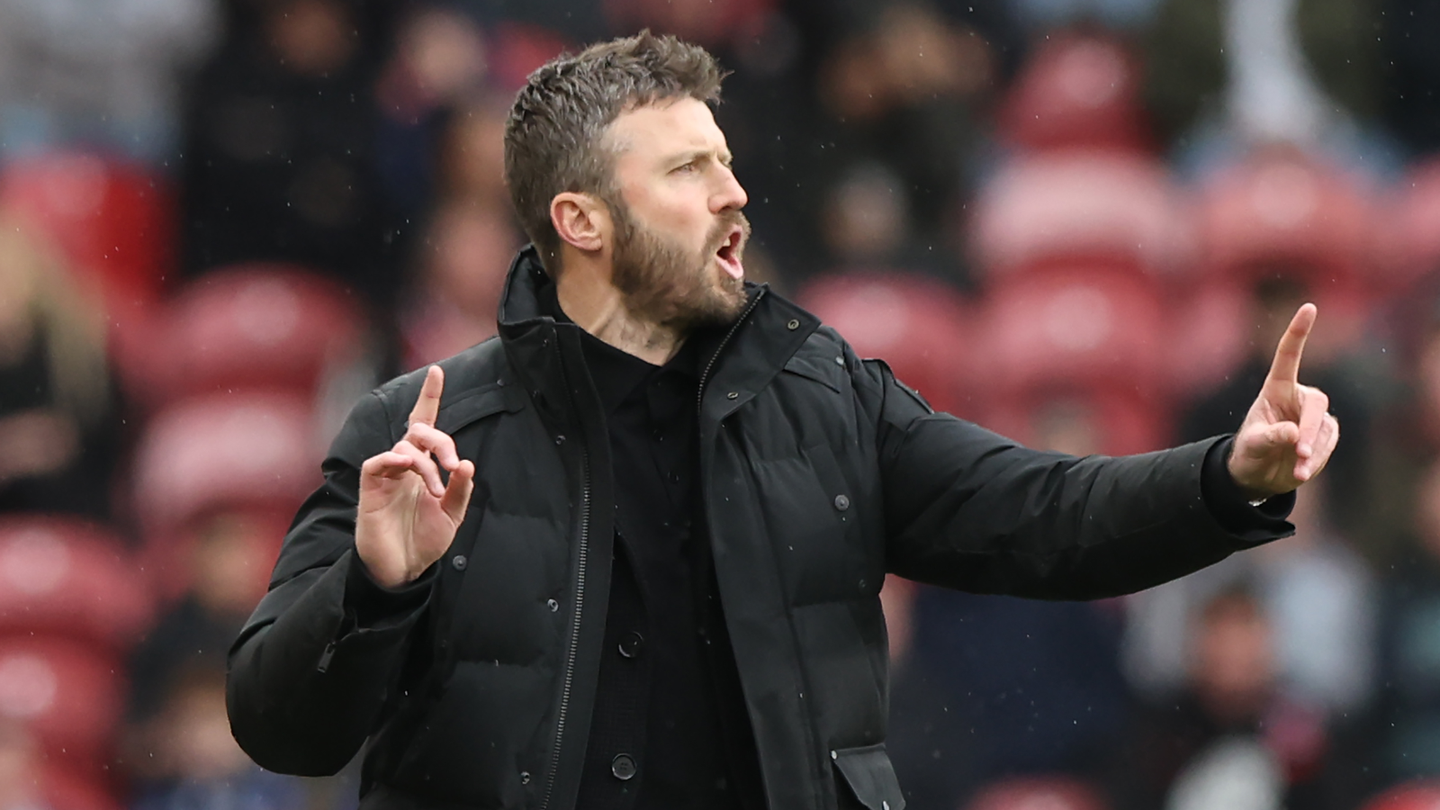
Ali Tweedale of Opta Analyst looks at Michael Carrick's time in charge of Middlesbrough and the learnings he could take into his new role at Manchester United.
It was clear from the names in the conversation to become Man Utd’s interim manager that their search involved trying to reconnect the fans with the club.
The initial favourite to replace temporary boss Darren Fletcher as interim head coach until the end of the season was former United player and manager Ole Gunnar Solskjaer, but in the end, Man Utd turned to another club legend in the shape of Michael Carrick.
Carrick played 464 games for Man Utd between 2006 and 2018, mostly under Sir Alex Ferguson, and won 18 trophies in total. Talk of bringing back Man Utd’s "DNA", which is essentially an aim to play attacking football, appeared key to his appointment, and Carrick, having been a big part of a hugely successful period in Man Utd's history, should have some of that.
Fletcher’s two games in charge, a 2-2 draw at relegation-threatened Burnley and this weekend’s FA Cup defeat by Brighton & Hove Albion, which has guaranteed that Man Utd will play only 40 games in total this season, have proved that “knowing the club” may be important, but it certainly isn’t sufficient.
So, what will Carrick, a former midfielder like Fletcher, bring to his old club?
First and foremost, his arrival will likely mean an end to Ruben Amorim’s commitment to playing with a three-man defence. While in charge of Middlesbrough for almost three seasons between October 2022 and June 2025, Carrick’s side started in a 4-2-3-1 formation in 112 of 124 Championship games.
Formations used by Carrick at Middlesborough
| Formation | Matches |
|---|---|
| 4-2-3-1 | 112 |
| 4-4-2 | 6 |
| 3-4-1-2 | 3 |
| 3-5-2 | 1 |
| 4-4-1-1 | 1 |
| 5-4-1 | 1 |
He played with a back three or five in five of those games, but rarely made changes of formation within matches, instead preferring to make like-for-like changes to freshen up the players on the pitch, rather than changing shape.
It was something for which he came in for some criticism while at the club. Following Amorim, who stuck to his formation in the face of the worst Premier League win rate of any permanent manager in the club’s history (31.9 per cent) – Carrick may need to show a little more flexibility.
Man Utd managers' Premier League win rates
| Matches | Win% | |
|---|---|---|
| Ruben Amorim | 47 | 31.9% |
| Ralf Rangnick | 24 | 41.7% |
| David Moyes | 34 | 50.0% |
| Louis van Gaal | 76 | 51.3% |
| Ole Gunnar Solskjaer | 109 | 51.4% |
| Erik ten Hag | 85 | 51.8% |
| Jose Mourinho | 93 | 53.8% |
| Sir Alex Ferguson | 810 | 65.2% |
The football that Middlesbrough played under Carrick was pleasing on the eye, though, and should in theory provide the Man Utd fans with something they find easy to get behind and believe in.
Of the ever-present teams in the Championship over Carrick’s time at Middlesbrough, his team ranked top for goals, shots, expected goals, successful passes and touches in the opposition box, and second for average possession (55.2 per cent). It was front-footed, dominant football with the intention to grind down the opposition through keeping hold of the ball.
However, Carrick failed to get Middlesbrough promoted. His side were top in those above categories – and by definition one of the better sides – among the teams who remained in the Championship, but they weren’t better than the teams who got promoted. His side were never quite good enough to get out of the league, consistently falling just short.
Of Carrick's three seasons at Middlesbrough, the most relevant is his first – 2022/23 – when he took over from Chris Wilder, who employed a very different footballing philosophy. Carrick arrived in late October with the team in 21st place and staring at the possibility of a relegation battle. He swiftly turned the season around, winning 13 of his first 17 matches in charge to fire them up to third and four points off the automatic promotion spots by mid-February.
Based on that evidence, it looks fair to assume that Carrick has what it takes to turn an underperforming team’s season around while implementing a new style of play.
Results faltered through the spring as Middlesbrough won only three of their final 10 games of the season and ended up finishing fourth, before losing out to Coventry City in the playoffs, but by that time, Carrick had won the fans over, and that is particularly relevant for Man Utd given their current situation. The difference for Man Utd is that they are much later into the season and are only three points off fourth place. There is much less of a turnaround needed.
From when Carrick took over until the end of the regular season (excluding the playoffs) in his first season in charge, Middlesbrough ranked third in the Championship for possession (58.9 per cent), passing sequences of at least 10 passes (379), and passes per sequence (3.9), and were second for what are called build-up attacks, which are defined as open-play sequences of 10+ passes that end in a shot or touch in the opposition’s box, of which there were 77.
They were hugely successful playing this new possession-based game; Middlesbrough scored 65 goals, more than anyone else in the Championship in that time and ranked first for xG, too (51.9).
They didn’t only play slow, possession football, though. Much like Ferguson's best Man Utd teams, Carrick’s Middlesbrough attacked at pace when they had the opportunity to. Only Coventry had more shots from fast breaks than their 21, while Boro led the league for goals from such situations, with nine.
Given Middlesbrough outscored their xG by a whopping 13.1 – unsurprisingly the biggest difference in the division – there was an element of the players being carried by the confidence Carrick had given them. Perhaps their regression over the next two full seasons under him, in which they finished eighth and then 10th, should have been expected.
For now, given Man Utd seem to be planning to appoint a permanent manager in the summer, the lure of a new-manager-bounce-type effect for the next five months might be exactly what they need.
For Carrick's second and third seasons at Middlesbrough, the numbers became less impressive as the team lost momentum.
Possession remained key but some fans grew frustrated at a lack of cutting edge as opponents worked out that Boro would struggle to break down a low block. They still attacked at pace when they had the chance, but a commitment to wearing opponents down with the ball ultimately became Carrick’s downfall. They tried to play like some of the best teams to get promoted, but could not replicate their success.
It is worth mentioning some of the challenges that he faced to provide some context to his failure to guide Middlesbrough back into the Premier League. Most notably, key players were sold throughout his time at the club, including Morgan Rogers to Aston Villa in the winter transfer window in early 2024.
Carrick also lost his team’s top scorer in his first two seasons at the club, with Chuba Akpom moving to Ajax in the summer of 2023 after scoring 29 Championship goals – the most in the league – and Emmanuel Latte Lath leaving for Atlanta United midway through the following campaign, after top-scoring in 2023/24 with 18 league goals. Tommy Conway, signed from Bristol City in August 2024, proved an inadequate replacement.
Injuries also played a part, most notably during a terrible injury crisis in 2023/24, and then last season, when key player Ben Gannon-Doak, on loan from Liverpool, suffered a serious hamstring issue in February. Gannon-Doak's absence for the last three months of the campaign extinguished any remaining chance of a late push for the playoffs.
However, despite these difficulties, it was a tactical inflexibility that ultimately did for Carrick. He stuck too steadfastly to his preferred style, and that meant patience with him ran out.
It may be that Carrick will need to adapt more than he did at Middlesbrough and, still so early in his managerial career, there’s no reason he can’t learn to do just that.
In the short term, the confidence Carrick breeds in his players and the immediate impact he had in such a brief spell at Middlesbrough both bode well for his attempts to steady the ship at Old Trafford.