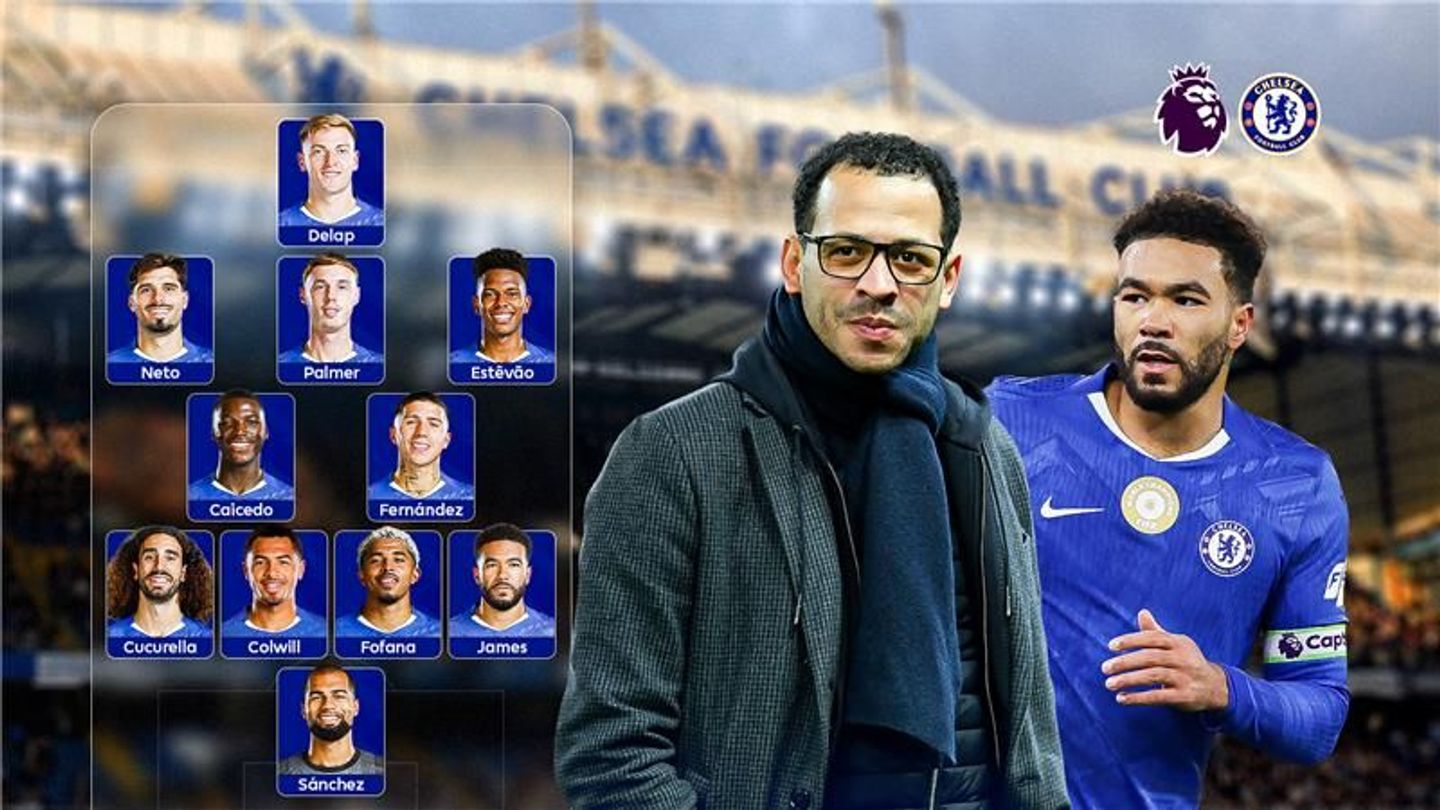
Following the appointment of Liam Rosenior at Chelsea, Alex Keble looks at what the new head coach will bring to Stamford Bridge.
“Should I get the opportunity to coach… I would be looking to combine the beautiful with the practical,” Liam Rosenior wrote in 2018, signing off a Guardian column that praised not just Pep Guardiola and Jurgen Klopp but their tactical antithesis, Jose Mourinho, too.
Combining “the beautiful with the practical” is a tidy definition of Rosenior’s tactics at Strasbourg, where his blend of possession football with purposeful transition-focused attacks took them into the UEFA Conference League.
Strasbourg do not press manically in the final third yet they are a hard-pressing team who look to win the ball back quickly. They do not dominate possession in the opponent’s half but they will hold it for long periods.
They are not a counter-attacking side but do prefer to move quickly through the thirds.
They are bang in the middle, neither one thing nor the other, as Opta’s team style graphic for France's Ligue 1 shows.
That is a compliment, not a criticism. Flexibility is a core part of Rosenior’s approach, although there are also clear principles of play that, in theory, align with the Chelsea squad and the club's owners.
Emery-like possession with purpose should suit the Chelsea squad
Rosenior’s Strasbourg liked to play lots of short passes, using possession to produce entertaining football rather than suffocate the opposition.
In short, he wants possession with purpose: attacks constructed in minute detail (look out for automatisms: pre-set passing moves coached in training) that look to draw the opposition forward by baiting the press before spinning behind with incisive forward passes.
A close comparison in this regard is Unai Emery, whose Aston Villa see plenty of the ball in their own half but only to manipulate space; only so they can arrive in the final third at speed, as if on the counter-attack.
Strasbourg have attempted fewer long balls (504) than any other side in Ligue 1 and the fewest switches of play (12), and indeed across Europe’s top five leagues only Paris Saint-Germain (PSG) and Barcelona have a lower share of their passes hit long than Strasbourg’s six per cent.
But almost paradoxically, while only Marseille and PSG have completed more passes than Strasbourg’s 8,257, Rosenior’s side averaged just 52.9 per cent possession (the seventh-most).
So, Strasbourg were happy to take a long time passing it around at the back - only to suddenly change gears. They top the Ligue 1 charts for through-balls (56) and rank second for take-ons attempted (321) and completed (143).
That does not mean they are ultra-direct, however. Interestingly, Strasbourg have recorded the second-fewest fast breaks (nine) in Ligue 1, whereas Chelsea have recorded the second-most in the Premier League (30).
That’s because Rosenior’s side preferred to recycle possession in order to stop games getting stretched, only piercing lines when they were in control.
The good news is that Chelsea’s high number of fast breaks shows their squad is full of pace and counter-attacking potential, meaning it should be able to adapt well to the new verticality; to a more flexible approach that looks to draw out the opposition press before cutting lines.
Rosenior’s out-of-possession tactics may be adapted to suit Chelsea
Off the ball, Rosenior’s Strasbourg aimed to win the ball back as quickly as possible, although they were not manic full-pitch pressers. Five teams have more high turnovers in Ligue 1 than Strasbourg’s 143 but only PSG (seven) scored more goals from these turnovers than Strasbourg (five).
A combination of quick counter-pressing (just after the ball is lost) and a tight midblock (Strasbourg tended to sit off in a 4-4-2 rather than hound the ball constantly) created a mean defence; Rosenior’s side conceded the fourth-lowest Expected Goals (xG) in Ligue 1 this season (21.43).
Again, their defensive style shows flexibility; shows the beautiful and the practical. On that note Strasbourg sit ninth, almost exactly in the middle, for passes per defensive action (PPDA), with 11.8, a measure of pressing intensity.
This is fairly similar to how Maresca coached Chelsea’s out-of-possession structure, albeit at a lower intensity (Chelsea’s PPDA of 10.0 is the lowest, therefore most intense, in the Premier League).
That could mean Chelsea sit behind the ball more often from now on, although Rosenior’s jump from a midtable club to one with title-winning ambitions means adaptation is likely.
That’s what being pragmatic really means: changing to fit the circumstances, even if that leads to more attacking, not less.
Indeed, Rosenior could never have expected to dominate possession or press aggressively when managing a team of Strasbourg’s status (or Hull City’s for that matter). Things could look very different at Chelsea.
Rosenior’s unusual use of the goalkeeper is the only area where Chelsea may struggle
So, there are plenty of reasons to assume Rosenior can hit the ground running.
Composed and controlled possession is a foundation the Chelsea players already understand from Maresca; the added emphasis on verticality under Rosenior should be easily learnable for a squad who counter-attack so quickly this season; and Rosenior’s probable move to higher-octane pressing should align roughly with the Maresca era.
But one problem Chelsea might come up against is Rosenior’s unusual deployment of the goalkeeper, whose positioning sums up the new manager’s forward-thinking football.
Robert Sanchez will be expected to come very far out of his box to form part of the defensive line when Chelsea have possession, the idea being to give his team-mates an extra passing option and create an overload in the build-up.
So far this season no Ligue 1 goalkeeper (min. 900 minutes) averages more touches outside of their penalty area than Mike Penders’ 39.4 per 90. At times, Rosenior deploys his goalkeeper more or less as an outfield player.
In turn, this risky use of the goalkeeper encourages the opposition press, taking us back to that core principle of Emery-like press-baiting.
And, naturally, using the goalkeeper to draw the press is a risky strategy for such a young Chelsea team, just as it was for a young Strasbourg team. They top the Ligue 1 charts this season for errors leading to a shot (17).
Chelsea’s squad should enjoy Rosenior’s style of football
However, Sanchez was signed for how good he is with his feet and the club's transfer strategy has always favoured ball-playing, line-breaking centre-backs.
Wesley Fofana and Trevoh Chalobah (and Levi Colwill once he returns from injury) in particular are very good at finding progressive passes when under pressure.
If Rosenior picks a consistent defence more often than Maresca did he should create a partnership that can cope with inviting the press.
Nevertheless, defensive errors resulting from a lack of senior players was an on-going concern for Maresca. It’s easy to imagine Rosenior, himself young and inexperienced, having similar issues.
Errors leading to shots and goals since Maresca's appointment
| Team | Total |
| Spurs, Aston Villa | 65 |
|---|---|
| Chelsea | 61 |
| Man City | 53 |
| Southampton | 51 |
| Newcastle | 49 |
| Fulham | 48 |
| Everton | 47 |
| Liverpool, Nottingham Forest | 46 |
Further up the pitch, Andrey Santos has excelled recently and was superb playing for Rosenior at Strasbourg, although he will still struggle to get into the team ahead of Moises Caicedo and Enzo Fernandez, whose mix of all-action defending (Caicedo), possession recycling (Fernandez), and bursting dribbles through the thirds (both players) is perfect for the new head coach.
In attack, Rosenior is again unlikely to make major changes to Maresca’s team – or formation. Pragmatic assessment of the squad at his disposal means Rosenior is likely to abandon the 3-4-3 most often used at Strasbourg in favour of the 4-2-3-1 used at Hull City.
Cole Palmer should start as the No 10, with Estevao Willian on the right (Rosenior invests heavily in youth) and Pedro Neto on the left. Alejandro Garnacho’s tendency to track back slowly does not align with the more conservative aspects of Rosenior’s out-of-possession coaching.
Predicted line-up (4-2-3-1): Sanchez; James, Fofana, Colwill, Cucurella; Fernandez, Caicedo; Estevao, Palmer, Neto; Delap
Liam Delap, as a sharper and more piercing attacker than Joao Pedro, is the likeliest to lead the line, although from this summer he will compete with Strasbourg captain Emmanuel Emegha, who made his name under Rosenior.
Finally, stitching it all together, Marc Cucurella and Reece James (or Malo Gusto) will pour forward or invert into central midfield depending on the opponent. Maresca’s great tactical contribution to the Premier League was his innovative use of full-backs and Rosenior will surely continue the project.
And that is very much Rosenior’s brief: continue the club's project. Evolution not revolution. Judging by his time at Strasbourg, Rosenior will attempt – subtly - to shift Maresca’s slower chess-ball into a more purposeful and direct take on the possession game.