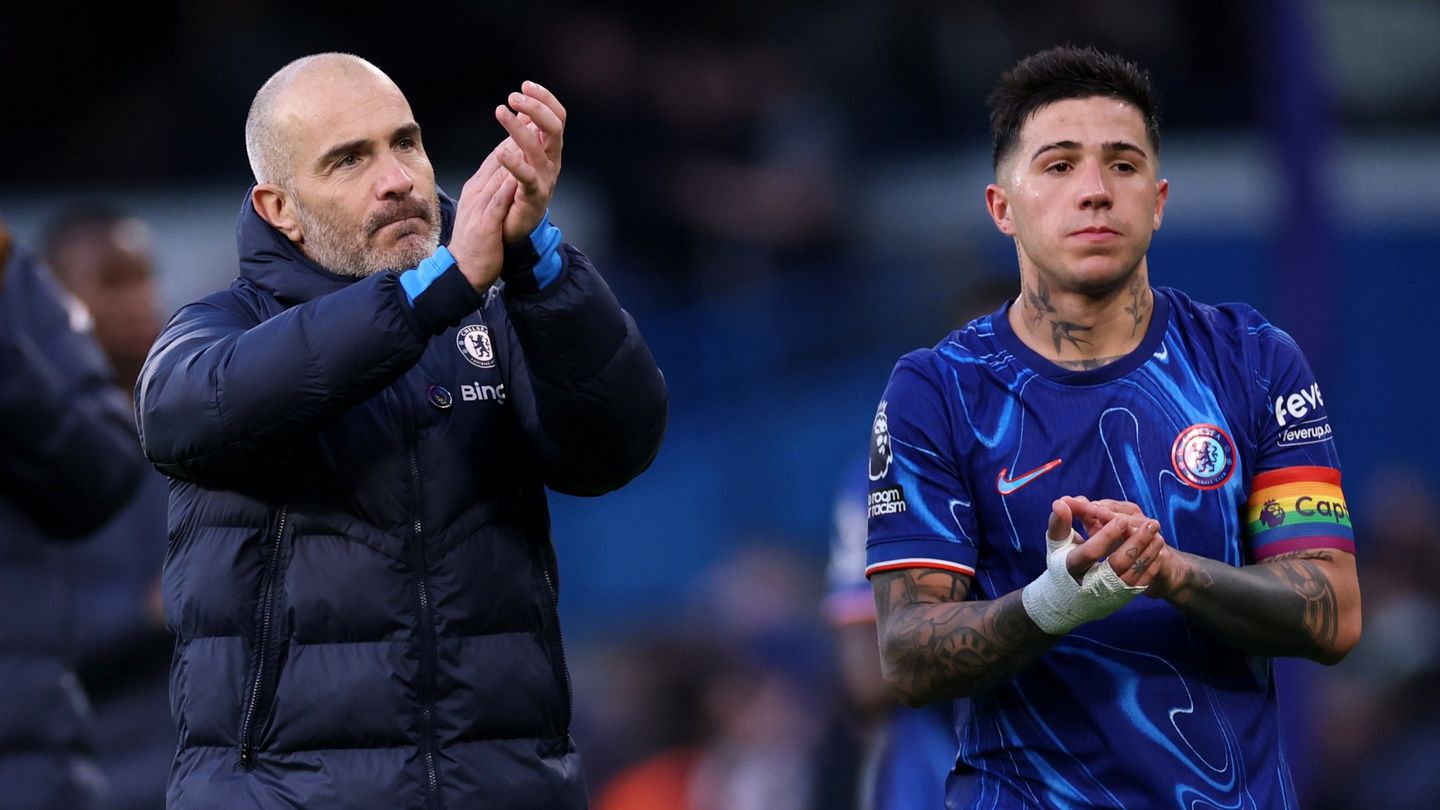
Following Enzo Maresca's exit from Chelsea on New Year's Day, football writer Alex Keble looks at the Italian's legacy there and the leading candidates to succeed him.
Enzo Maresca is no longer Chelsea's head coach and, in keeping with the suddenness of his departure, he leaves a confusing and complicated legacy.
On the one hand, Maresca made Chelsea the FIFA Club World Cup champions over the summer after winning the UEFA Europa Conference League in May, making him their most successful manager since Thomas Tuchel led them to UEFA Champions League glory in 2021.
Maresca lifts the Conference League trophy in May
On the other, it was widely expected that Chelsea would kick on from their Club World Cup triumph in July. That simply has not happened.
Inconsistency in the Premier League has resulted in Chelsea’s points-per-game average dropping this season compared to last and domestically at least, there is little sign that the club have made progress towards their objective of winning their first league title since 2017.
Chelsea's average Premier League points per game (PPG)
| Season | Manager | PPG |
| 2023/24 | Pochettino | 1.66 |
|---|---|---|
| 2024/25 | Maresca | 1.82 |
| 2025/26 | Maresca | 1.58 |
Here’s the story of Maresca's time at Chelsea – and a look at what could happen next at Stamford Bridge.
Maresca's tactical innovations boosted Caicedo, Cucurella and others
Ultimately what Maresca will be remembered for is the Club World Cup triumph in New Jersey and the shock 3-0 destruction of Champions League winners Paris Saint-Germain in the final.
It is a fitting way to remember Maresca: a superb tactical victory for one of the smartest tacticians around.
He abandoned his usual possession-centric, Pep Guardiola-inspired football to harass PSG with a high man-to-man press, to win the ball and break quickly in behind Luis Enrique’s high line. The favourites didn’t know what hit them.
Maresca lifts the Club World Cup trophy after masterminding Chelsea's win over PSG
Unfortunately that would prove to be Chelsea’s peak under Maresca, although there were many other highs.
His detailed organisation of positional play when in possession was impressive, creating patterns that enabled the team to consistently create chances, despite lacking a goalscoring No 9 throughout his tenure.
Since Maresca's arrival, Chelsea’s "Expected Goals on Target" figure is 106.22, only marginally behind the leaders Liverpool, on 106.26.
Maresca's football also got the best out of the likes of Moises Caicedo, Marc Cucurella, Enzo Fernandez and Reece James; the latter's repurposing in central midfield is one of the head coach's best achievements in recent months.
But the Italian's single biggest tactical contribution to English football has been an innovative use of full-backs, who, building on the recent trend to invert them into central midfield, were often deployed by Maresca as No 8s expected to crash into the box.
Cucurella and Malo Gusto often seemed to play at right-back, No 6, No 8 and right winger all in the same game – and sometimes in the same move – as part of a clever shape-shifting Chelsea setup that helped Cole Palmer, Joao Pedro and Estevao excel.
Critics will point to Maresca's tactics sometimes appearing stale and overly rigid, although that was only the case for portions of 2024/25, when the players struggled to unlearn the direct ways of Mauricio Pochettino and found laying the foundations difficult.
This season, things looked more dynamic, particularly in attack, only for issues in the defence to undermine Maresca's plans.
A young team, defensive errors, and squad rotation led to Maresca's downfall
Maresca never once fielded a player over 30. That extraordinary statistic illuminates some of the problems he faced presiding over the youngest squad in the Premier League (24 years and 112 days average).
Since Maresca's first game in charge, Chelsea have made 41 errors leading to a shot and 18 leading to a goal, on both counts the third most in the Premier League. They also rank fourth for points lost from a winning position (30).
The leadership, stoicism, consistency and gamesmanship that come with experience often appeared to be lacking.
Chelsea had a strong tactical platform - but they were too brittle, too naive. Maresca's frequent changes to the back four hardly helped in that regard.
In just 19 Premier League matches this season, Maresca has made a grand total of 25 changes to his back four between games, making two or more changes 11 times.
He also made a further 23 changes in defence via substitutions and, overall, has started seven unique back fours in 2025/26.
All those changes reflect Maresca's difficulty in finding the right balance this season, culminating in a run of just one win in seven Premier League matches, in his sudden departure, and in a leap into the unknown for Chelsea.
What’s next: Rosenior leads potential continuity candidates
The heavy favourite to replace Maresca is Liam Rosenior, who has impressed at Chelsea’s sister club Strasbourg, taking them into the UEFA Europa League via a seventh-place finish in Ligue Un last season.
Rosenior is known for a high-intensity pressing game and a brand of attacking possession football that is, in broad strokes, similar to Maresca's understanding of the game.
He is a continuity candidate of sorts, reflecting Chelsea’s belief that tactical consistency between head coaches is the best way forward.
"Any new manager won’t have a different style of play," BBC Sport’s Chelsea correspondent Nizaar Kinsella reported on X. "There are multiple candidates but not from a very wide field."
Other names being linked with the Chelsea vacancy include Oliver Glasner, Xavi, Cesc Fabregas and Roberto De Zerbi, but there is a huge variety of tactical approaches in that supposed shortlist, suggesting not all of those mentioned in the media are under consideration.
Whoever leads Chelsea into 2026, it seems highly likely the owners’ policy of investing in young talent – on the field and in the dugout – is set to continue.
Whether or not the club can achieve their aims with that approach, and can find the stability and steady upward trajectory they seek while prioritising potential over the finished product, remains to be seen.
Certainly the Maresca era – when a fresh young coach in his first top-division job brought the highs of major silverware and the lows of Premier League stasis – leaves the question open.