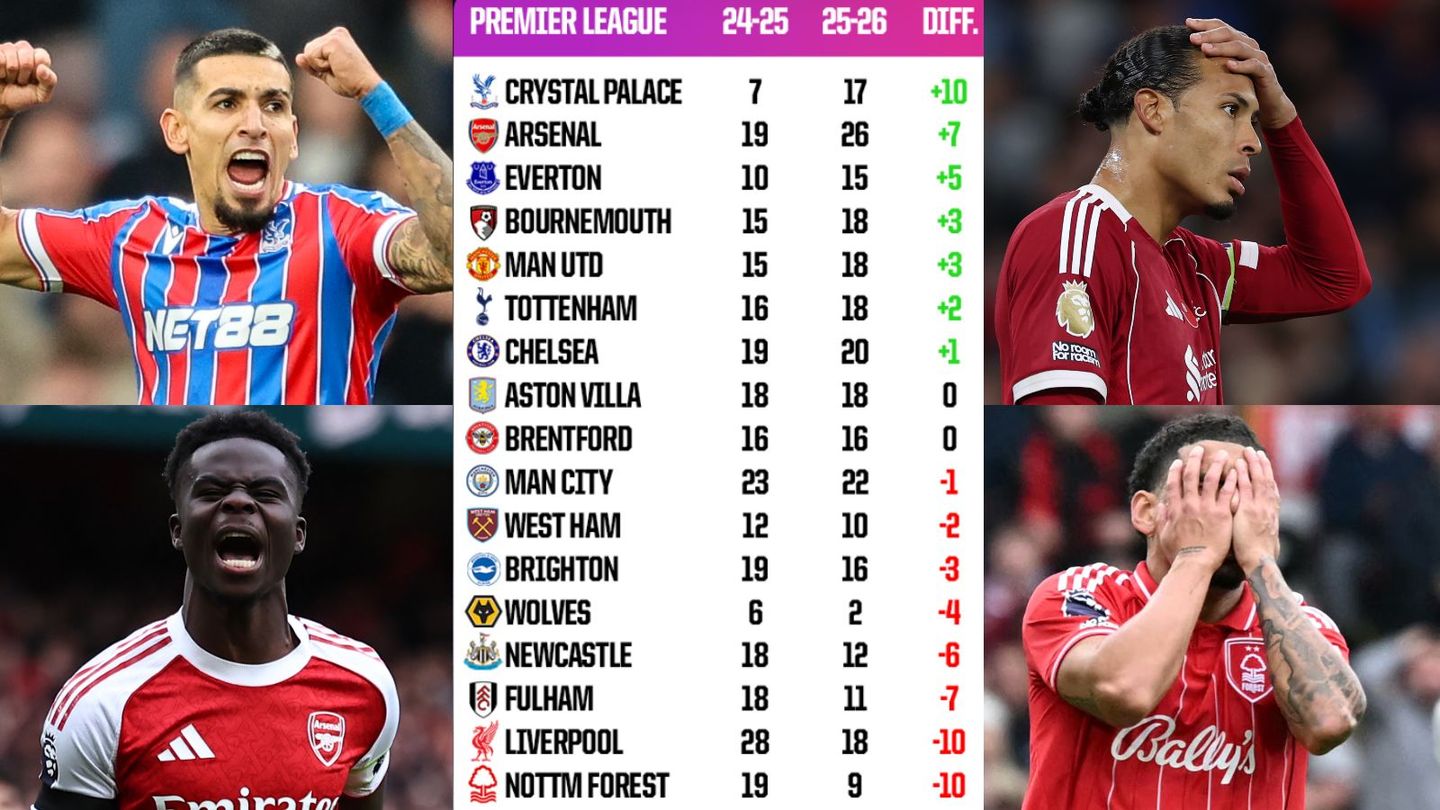
Ryan Benson of Opta Analyst examines the first 11 Matchweeks to see which teams have done considerably better or worse this season than at the same point last season.
Football would be rather boring if all the same things happened every season, but that doesn’t stop us being surprised when our expectations are exceeded – or aren’t met.
That’s one of the primary charms of sport: it always keeps you guessing.
With that in mind, we probably ought to be particularly grateful to the Premier League teams this season who’ve deviated most significantly from their past selves of about 12 months ago.
The third international break of the 2025/26 season provides an opportune moment to reflect on the season to date thanks to the amount of time we have with all teams locked on 11 matches played. It also means we have a sizeable chunk of the season out of the way, so we can start drawing some conclusions as we are no longer dealing with the dreaded “small sample size”.
Sure, you can just look at the Premier League table as it is. After all, that’s what we use at the end of the season to determine who’s had a good campaign or not.
But in some respects, the table lacks context. For instance, Manchester United being seventh in the table right now might look underwhelming considering their great history of success, but actually most people would probably agree they’ve shown some reasonable signs of progress from 2024/25, which was historically bad for them.
So, we’ve decided to compare the 2025/26 Premier League standings through 11 Matchweeks to that of 2024/25 at the same point to hopefully provide some context to each side’s respective starts to the campaign.
On the up?
Man Utd are a good team to start with and a fine example of how perceptions change with expectations.
They’ve only actually taken three more points through their first 11 matches of 2025/26 than 2024/25, which saw Erik ten Hag sacked after three wins from their opening nine games before Ruud van Nistelrooy oversaw a draw with Chelsea and a win over Leicester City.
Understandably, the mood at Old Trafford is rather more mellow now. Granted, it wasn’t a few weeks ago, though a positive run of five Premier League games without a defeat has been very welcome.
They aren’t doing dramatically better than this time last year when looking at the table, then, regardless of the improved mood. But when you consider that only three teams have taken more than an additional three points compared to the same point in 2024/25, Man Utd can feel encouraged.
Out in front when it comes to a year-on-year improvement in the points department are Crystal Palace.
Oliver Glasner has transformed the Eagles into one of the Premier League’s most effective and entertaining teams since he arrived at the club, but doom and gloom was threatening to envelop Selhurst Park this time last year.
Palace had just seven points on the board after 11 matches in 2024/25. Glasner was under pressure, with reports suggesting in October 2024 that he had four games to save his job.
They hadn’t won any of their first eight league games for the first time in the top flight since 1992, but from Matchweek 9 onwards, they suffered one defeat in eight matches to steady the ship. And it’s just as well that Palace showed patience, as Glasner went on to lead the club to their first ever major trophy in the FA Cup, and their highest Premier League points tally of 53.
In 2025/26, then, they’ve taken 10 more points than the seven they accumulated after Matchweek 11 in 2024/25, making them the Premier League’s most-improved side in that sense, despite their schedule being the second toughest until now, according to the Opta Power Rankings.
The Opta Power Rankings are a global team-ranking system that assigns an ability score to over 10,000 domestic clubs on a scale between zero and 100, where zero is the worst-ranked team in the world and 100 is the best team in the world. The average Opta Power Rating of Palace’s opponents this season is 92.7, second only to Liverpool’s 93.0. And while they may only be as high as 10th, that puts them just three points off Chelsea in third.
Compared to the same period last season, their non-penalty Expected Goals (NPxG) is up significantly (13.25 to 17.71) and their non-penalty Expected Goals Against (NPxGA) has dropped from 16.43 to 11.95, suggesting vastly improved efficiency at both ends of the pitch.
Leaders Arsenal are the second most-improved side when looking at points totals compared to the same stage last season.
The Gunners have accumulated 26 points in 2025/26, giving them a four-point cushion at the summit. But after 11 matches in 2024/25, they were seven points worse off than they are now.
Their immense defensive record has undoubtedly played a part. Mikel Arteta’s side have conceded just five times in the league this season, three fewer than any other side, while their NPxGA of 6.13 is 3.52 lower than the next shrewdest defence (Manchester City – 9.65 xGA).
Then, when you also take their NPxG into consideration, they have a positive xG difference of 11.6, far superior to any other team this season or at the same stage of 2024/25 – they’re effective at both ends of the pitch, and you can’t ask for much more than that.
Everton are also doing comfortably better after 11 matches this season than last, with their 15 points up healthily from 10 for an increase of 50 per cent, even though in 2024/25 they were deemed to have the easiest start to the campaign.
However, there are actually more Premier League teams who’ve taken fewer points this season than by the same stage in 2024/25. Chief among them: Liverpool and Nottingham Forest.
It can only get better... right?
Champions Liverpool have endured a miserable start to 2025/26 by comparison. After winning their first five games, they’ve since lost five of their last six in the Premier League.
Five losses in the first 11 games of a season is the most suffered by the defending champions since Leicester in 2016/17 (also five), while only Chelsea in 2015/16 have ever been beaten more often (six times) at this stage of a campaign as reigning title holders.
It all adds up to them having 10 points fewer (18) than they had at the same stage last season (28), a start that set the foundation for their brilliant title success. No team have seen a greater year-on-year decline in points this season than that.
But we must remember it’s obviously easier to see a more significant decline in relative terms when you were so good before, because it’s difficult to maintain that level. For instance, 18 points hardly spells disaster for the Reds yet, even if no team have won the top-flight English title after taking as few points over the first 11 Matchweeks of a season since Everton in 1986/87.
It’s been one of the worst starts to a title defence in Premier League history, and yet they’re still only four points behind Man City in second. We also ought to mention that Liverpool’s start to the season has been the most difficult of all Premier League clubs, as highlighted in the 2025/26 Fixture Difficulty graphic further up.
If performances improve quickly, they’ll surely climb as the fixture schedule eases for them slightly, though it remains to be seen if Arne Slot can pull them out of their slump.
Speaking of slumps, the atmosphere at Nottingham Forest this season couldn’t have been much more different to that of 2024/25. It now feels like such a long time ago that they were challenging for the top four and ultimately qualifying for the UEFA Europa League (albeit because Palace were demoted to the Conference League due to multi-club ownership rules).
Forest are already on their third manager of the season following the dismissals of Nuno Espírito Santo and Ange Postecoglou, with Sean Dyche now attempting to get them back on course.
The stark difference in circumstances between this season and last, however, is best summed up by the fact they’d won 10 points more at this stage of 2024/25 (19). It doesn’t take a genius to work out that’s more than double the nine points they currently have.
Fulham (-7) and Newcastle United (-6) are also doing considerably worse in comparison to last season, while even Wolverhampton Wanderers have somehow fallen short of their dismal start to the previous campaign.
It took them until Matchweek 11 in 2024/25 to win their first league game of the campaign, having suffered seven defeats to that point. In 2025/26, however, they’ve still not claimed a single victory, going winless through their first 11 games for the first time since 1983/84, a season that ended in relegation from the top flight.
At this stage of 2024/25, Wolves had only six points, and yet they’ve still managed to miss that figure by four.
Positivity shrouded in uncertainty
Tottenham Hotspur deserve a special mention, too. Spurs have actually taken two more points this season than at the same stage of 2024/25, and if you were to just look at the table as it is, you’d probably think all was going rather swimmingly. But their xG figures make for very curious reading.
They have a negative NPxG difference (-4.11) because they’ve struggled to reliably create chances (11.09 NPxG, fourth-lowest) and given up opportunities at a substantial rate (15.2 NPxGA, fourth-highest). Compare that to this time last season when their 21.69 NPxG was the highest in the Premier League and 8.51 more than their 13.18 xGA.
Their fifth-place position in the table is made possible by the fact they’ve massively overperformed in relation to NPxG (+6.9) and NPxGA (+5.2). Considering the lacklustre nature of most of their performances this season, it’s difficult to look at those numbers as sustainable, as highlighted in our recent analysis of the Premier League’s expected points table.
Of course, none of this so far has taken into consideration what Leeds United, Burnley and Sunderland are doing. There’s an argument it’d be unfair to simply substitute results against the promoted clubs between the two seasons because the teams are so different to each other.
It is pertinent, however, to highlight that collectively their 40 points now is 18 more than the 22 Leicester (10), Ipswich Town (8) and Southampton (4) managed by this stage in 2024/25.
Granted, Sunderland’s 19 makes up nearly half of that accumulative total, but both Burnley (10) Leeds (11) have at least matched what Leicester managed. There’s a long way to go, sure, but right now it seems very unlikely all three promoted teams will be going straight back down for the third season in succession.
What will likely stand them in good stead is the fact they appear more cautious than last season’s promoted teams. Burnley, Leeds and Southampton have a combined difference of -17.2 between their collective NPxG (30.24) and NPxGA (47.47), whereas last term Ipswich, Leicester and Southampton had a difference of (-33.05) between NPxG (32.02) and NPxGA (65.07).
Given the misguided nature of Leicester and Southampton’s survival bids last season, it stands to reason that the promoted clubs might look to be less expansive. Whether it pays off in the end is another matter, but the Opta Power Rankings suggest the collective standard of the Premier League has improved. The competition is simply tougher, so, prioritising being difficult to beat seems sensible.
Ultimately, the only table that really matters is the one we see upon the conclusion of Matchweek 38, but it’s a long road to that point, with lots of twists and turns. For some, judging by the underlying data, it could be a lot longer than it is for others.
Visit Opta Analyst for more Premier League statistics and articles.