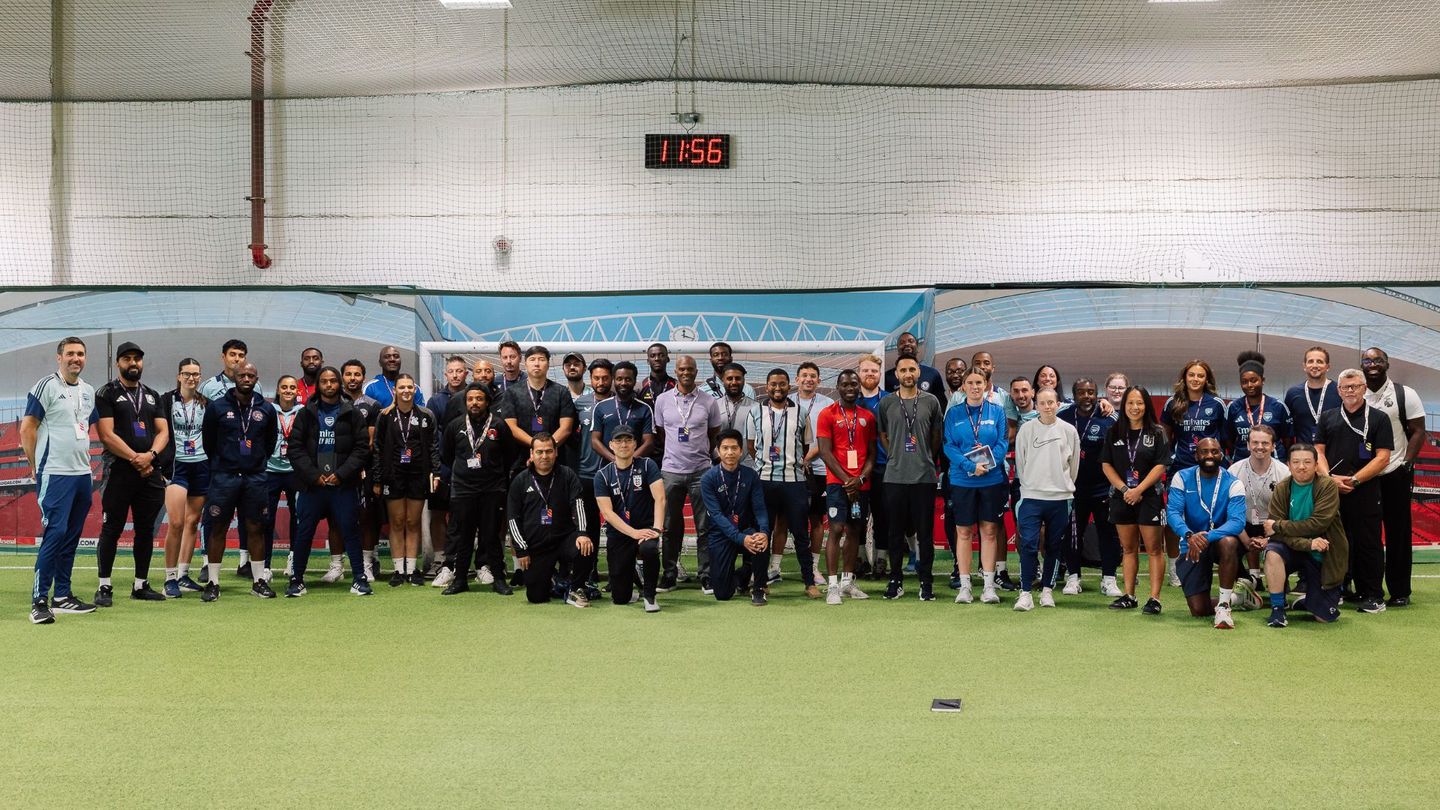
To continuously develop the best players, we need to continuously develop top coaches.
That's why the Coach Index and Arsenal came together to host the Coach Connect events, creating spaces for learning, sharing, and shaping the future of coaching.
The Coach Index is a self-registration platform created by the Premier League with The FA, EFL, LMA and PFA to give coaches from underrepresented communities (Black, Asian, mixed heritage and female coaches) greater access to professional opportunities with more than 500 coaches having already registered to the platform.
Designed to address underrepresentation in coaching, the Coach Index connects qualified candidates with clubs and aligns with the Premier League's No Room For Racism Action Plan, helping build a more diverse and inclusive coaching workforce.
Over the last three seasons, the Coach Index has provided over a dozen events for members to access.
These events have included in-club Academy visits, developmental workshops targeted at improving their overall expertise as a coach as well as core employability skills. To date, over 100 coaches have accessed one of these events
"One of the biggest challenges in improving diversity in coaching is belief," said Osei Sankofa, the Premier League's Head of Coaching Pathways, setting the tone for the two-day event.
"Belief from underrepresented communities that this game is for them.
"The Coach Index exists to break down those barriers.
"It’s about giving people the confidence to go for the careers their ability deserves."
For the Coach Connect event, over 50 coaches from across the football pyramid were invited by the Premier League and Arsenal to a two-day event to share, learn and build connections.
Adam Henry, Senior Manager for Sport, Health and Wellbeing at Arsenal in the Community, spoke about the club’s responsibility: "Diverse teams perform better.
"It’s not just the right thing to do, it’s a performance benefit.
"If your coaching team doesn’t reflect your community, you’re failing them."
Osei Sankofa and Adam Henry
Day One
The first day took place in a conference room in East London, with Josh Hinckson introducing the Arsenal Academy philosophy, followed by Freddie Hudson MBE presenting Arsenal in the Community and their work in education, social inclusion, and wellbeing.
Hinckson, now an Arsenal U13s Academy coach, spoke about what had made the difference for him: "If I didn’t have that chance a few years ago, my life could’ve gone in a completely different direction, mentally, financially, motivationally."
Hinckson is a past participant on the Premier League’s Coach Inclusion and Diversity Scheme (CIDS), one of the League’s key programmes in diversifying coaching pathways and credits the initiative with transforming his career: "CIDS was the foundation, the next evolution in my coaching journey.
"It gave me the chance to go full-time, and that changed everything, from my motivation to the resources I could access and the way I saw the game.
"Without it, I’d be in a completely different place."
Josh Hinckson and Freddie Hudson MBE
Coaches then took part in practical breakout sessions covering three themes.
In the orange room, Carl Plunkett, Premier League Coach Developer, and Barry Quin, Premier League Elite Coach Development Specialist, explored how communication shapes player experience and team reactions.
In the pink room with Martyn Rothwell, Coach Development Consultant, the focus was on designing sessions that develop consistent, skilful behaviours.
Meanwhile, in the blue room, Abdul 'Butch’ Fazal, EDI Lead for the men's game at The FA, and Daljinder Jagpaul, Premier League Coaching Projects and Planning Manager, examined building a coaching identity while embedding equity, diversity and inclusion.
In that breakout session led by Fazal and Jagpaul, participants debated what their "coaching brand" was. Not just their style on matchday, but the values they wanted their players to see every session.
Fazal, challenged them with an experiment: "If you were in a lift with Pep Guardiola for 30 seconds, how would you sell your coaching philosophy and values?"
Abdul 'Butch' Fazal
A simple question that forced everyone to be clear about what they stood for.
"If you don’t know why you coach, your players won’t either," Fazal reminded them.
The day wrapped up with a panel discussion, where speakers and participants shared their personal coaching journeys, the obstacles they encountered, and the lessons that shaped their careers.
People were sat in small groups, sharing their "why" with strangers who quickly became collaborators.
For Hope Parsons, part of the Arsenal NCFE (Northern Council for Further Education), that "why" was clear: "I couldn’t find a girls’ team when I was younger.
"That really stuck with me, now I coach because I don’t want any other girl to feel like football isn’t for them."
Hope Parsons
There were nods around the table. Everyone seemed to recognise that feeling of not belonging, and the power of turning that experience into motivation.
Day One in images
Day Two
The second day took place at the Emirates Stadium Community Hub, a space where Arsenal in the Community delivers grassroots programmes, health initiatives, and social inclusion projects.
Coaches, many of whom typically work alone in parks or school halls, now had the opportunity to observe experienced Arsenal Academy coaching staff as well as those from Arsenal in the Community lead sessions designed to be questioned, critiqued, and adapted.
There were no "this is the only way" answers. Instead, staff broke down why they structured sessions the way they did, how they managed group dynamics, and how they encouraged decision-making in young players.
Day two also featured a Q&A with former Arsenal midfielder Paul Davis, who shared insights from his playing and coaching career.
Paul Davis during the Q&A
During that moment, the focus was on guiding coaches through the challenges of their own journeys and offering them advice and personal experiences to help them grow both on and off the pitch.
Rupesh Popat, originally from Leicester, who flew in from Germany, where he coaches at Berliner Athletik Klub 07 in the fifth tier of German football, explained why that matters: "Events like this are full of coaches from diverse backgrounds, not just attending, but delivering sessions.
"That visibility is key, and it’s only possible because the FA and the PL are actively creating those platforms."
Courage, sacrifice, and the choice to leap
The most striking thing about Coach Connect wasn’t the curriculum but the bravery of the people in the room.
Eno Mwamba, 33, left a career in finance to pursue coaching full-time: "I’ve had recruiters approach me for major roles.
"But I knew, if I didn’t take the leap now, I might never do it.
"I’ve worked hard for this, I’m ready."
For Gemma Staple, 25, working with Crystal Palace for Life Foundation as a Female Engagement Officer, the goal was simple but profound: "If I can help just one player fall in love with football and want to stay in the game, that’s success."
These are people who wanted the chance to make football better, more welcoming, more representative.
Eno Mwamba and Gemma Staple
Beyond two days
As coaches packed up to leave Emirates Stadium on the second day, the topic of discussion was how to improve their coaching. How to make their clubs more welcoming. How to give players a sense of belonging.
That was the real win. Because for all the session, all the theory, all the notebooks filled with plans, the most crucial message anyone took away was simple: This game is for you.
Day Two in images
Find out how to register for the Coach Index here.